> For the complete documentation index, see [llms.txt](https://support.powerio.com/hub/llms.txt). Markdown versions of documentation pages are available by appending `.md` to page URLs; this page is available as [Markdown](https://support.powerio.com/hub/codesys-hvac/en/hvac-library/functionblocks/components/sequencesuptemp.md).
# SequenceSUPTemp
## `SequenceSUPTemp` (FB)
FUNCTION\_BLOCK SequenceSUPTemp
### Short description
> Supply air temperature control for an air handling unit with energy recovery (continuous recirculation damper system and energy recovery) including the releases for active heating and cooling.\
> \
> Typical application: supply air temperature control in an air handling unit
### Representation
### Functional description
#### General
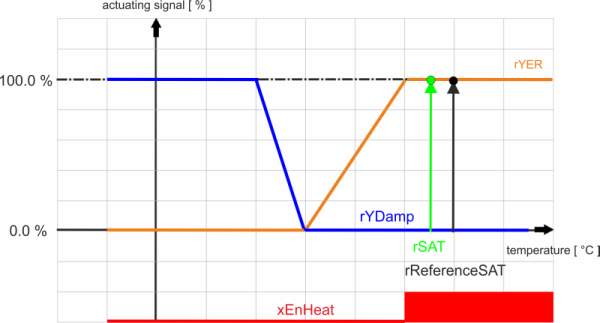
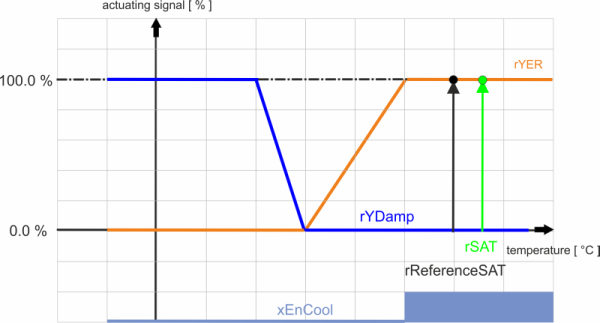
This function block enables, after the release (*xOpTCon* = TRUE) the control of the supply air temperature *rSAT* to the setpoint *rReferenceSAT* by generating the control signals *rYDamp* (recirculation damper system 0.0 - 100.0% outside air ratio) and *rYER*\
(energy recovery 0.0 - 100.0%).\
After the energy recovery systems have been fully utilized, active heating is enabled if required (*xEnHeat* = TRUE) or active cooling (*xEnCool* = TRUE).\
The control of the supply air temperature with active heating or active cooling must in each case be carried out by a separate external PI controller. The control signals of these external PI controllers are fed back to the inputs *rHeaterYPISAT* or *rCoolerYPISAT* fed back to ensure energy-efficient control of energy recovery.\
By taking into account the current outside temperature *rOAT* or exhaust air temperature *rRAT* the optimum energy recovery can be achieved for each operating condition.\
When using this block, the spatial arrangement of the components (damper system, energy recovery, heater circuit, cooling circuit, etc.) must be taken into account.\
\
Case 1 - Winter case: supply air temperature < supply air setpoint temperature, outside temperature < exhaust air temperature, supply air setpoint temperature > exhaust air temperature
Case 2 - Summer case: supply air temperature > supply air setpoint temperature, outside temperature > exhaust air temperature, supply air setpoint temperature < exhaust air temperature
#### Enable / disable the controller *xOpTCon*
In the disabled state (*xOpTCon* = FALSE) no control or regulation processes take place; the outputs are fixed to the following signals/states:\
\
*rYGen* = 100.0 %\
*xEnHeat* = FALSE\
*xEnCool* = FALSE\
*rYDamp* = 100.0 %\
*rYER* = 100.0 %
#### Enable / disable free night cooling *xFNCEn*
This input indicates (*xFNCEn* = TRUE) active free night cooling and blocks the output for active cooling *xEnCool* regardless of the remaining requirements.
#### Delayed start of control *xPRORamp* or *xHHWFrost1*
The internal sequence controller (PI controller) is blocked if either the input *xPRORamp* and / or the input *xHHWFrost1* is active (= TRUE).\
The internal sequence controller is enabled with a time delay of 5 minutes after both inputs are inactive again (= FALSE).
#### Feedback of the control signals *rHeaterYPISAT* or *rCoolerYPISAT*
The feedback of the control signals for active heating *rHeaterYPISAT* and cooling *rCoolerYPISAT* is monitored internally and evaluated as follows:\
\
Control signal *rHeaterYPISAT* > 8.0%: Deactivation of the internal sequence controller\
Control signal *rHeaterYPISAT* < 3.0%: Activation of the internal sequence controller after a delay of 500 ms\
\
Control signal *rCoolYPISAT* > 8.0%: Deactivation of the internal sequence controller\
Control signal *rCoolYPISAT* < 3.0%: Activation of the internal sequence controller after a delay of 500 ms
#### General control signal from the sequence control *rYGen*
This control signal in the range 0.0 - 100.0% (0.0% = maximum energy recovery, 100.0 = no energy recovery) is primarily generated by the internal sequence controller and influenced by the input variables *rSAT* (supply air temperature), *rReferenceSAT* (supply air setpoint temperature), *rOAT* (outside air temperature) and *rRAT* (exhaust air temperature).
#### Enable / disable active heating *xEnHeat*
Active heating is enabled (= TRUE) if the following conditions are met simultaneously:\
\
*xOptCon* = TRUE\
(outside temperature > exhaust air temperature AND *rYGen* > 99%) OR (outside temperature < exhaust air temperature AND *rYGen* < 1%)\
\
In all other situations, active heating is blocked (= FALSE).
#### Enable / disable active cooling *xEnCool*
Active cooling is enabled (= TRUE) if the following conditions are met simultaneously:\
\
*xOptCon* = TRUE\
(outside temperature > exhaust air temperature AND *rYGen* < 1%) OR (outside temperature < exhaust air temperature AND *rYGen* > 99%)\
*xFNCEn* = FALSE\
*rAverage2h* > **rSetpoint\_CoolOAT** (blocking active cooling at low outside temperatures)\
\
In all other situations, active cooling is blocked (= FALSE).
#### Control signal for the damper system *rYDamp*
The control signal for the damper system (0.0 - 100.0%, 0.0% = no outside air fraction, 100.0% maximum outside air fraction) is generated depending on the general control signal from sequence control *rYGen* as follows:\
\
The control signal *rYGen* is in the range *r1Damp* to *r2Damp* converted linearly into a signal in the range 0.0 - 100.0 and limited.
#### Control signal for the energy recovery system *rYER*
The control signal for energy recovery (0.0 - 100.0%, 0.0% = no energy recovery, 100.0% maximum energy recovery) is generated depending on the general control signal from sequence control *rYGen* as follows:\
\
The control signal *rYGen* is in the range *r1Er* to *r2Er* converted linearly into a signal in the range 100.0 - 0.0 and limited.
### CODESYS
InOut:
| Scope | Name | Type | Initial |
| ----------- | ------------------- | ------- | ------------ |
| Input | `rSAT` | `REAL` | |
| Input | `rReferenceSAT` | `REAL` | |
| Input | `xOpTCon` | `BOOL` | |
| Input | `xFNCEn` | `BOOL` | FALSE |
| Input | `rOAT` | `REAL` | |
| Input | `rRAT` | `REAL` | |
| Input | `rAverage2h` | `REAL` | |
| Input | `xPRORamp` | `BOOL` | FALSE |
| Input | `xHHWFrost1` | `BOOL` | FALSE |
| Input | `rHeaterYPISAT` | `REAL` | 0.0 |
| Input | `rCoolerYPISAT` | `REAL` | 0.0 |
| Output | `rYGen` | `REAL` | |
| Output | `xEnHeat` | `BOOL` | |
| Output | `xEnCool` | `BOOL` | |
| Output | `rYDamp` | `REAL` | |
| Output | `rYER` | `REAL` | |
| Output | `xAuto` | `BOOL` | |
| Input Const | `rSetpoint_CoolOAT` | `REAL` | 14.0 |
| Input Const | `r2ER` | `REAL` | 100.0 |
| Input Const | `r1ER` | `REAL` | 30.0 |
| Input Const | `r2Damp` | `REAL` | 30.0 |
| Input Const | `r1Damp` | `REAL` | 0.0 |
| Input Const | `rTn` | `REAL` | 200.0 |
| Input Const | `rKp` | `REAL` | 3.5 |
| Input Const | `rManValueYER` | `REAL` | |
| Input Const | `eManModeYER` | eMANNUM | eMANNUM.Auto |
| Input Const | `rManValueYDamp` | `REAL` | |
| Input Const | `eManModeYDamp` | eMANNUM | eMANNUM.Auto |
| Input Const | `eManModeCool` | eMANBIN | eMANBIN.Auto |
| Input Const | `eManModeHeat` | eMANBIN | eMANBIN.Auto |
| Input Const | `rManValueYGen` | `REAL` | |
| Input Const | `eManModeYGen` | eMANNUM | eMANNUM.Auto |
---
# Agent Instructions
This documentation is published with GitBook. GitBook is the documentation platform designed so that both humans and AI agents can read, navigate, and reason over technical content effectively. Learn more at gitbook.com.
## Querying This Documentation
If you need additional information that is not directly available in this page, you can query the documentation by asking a question.
Perform an HTTP GET request on the following URL with the `ask` and `goal` query parameters:
```
GET https://support.powerio.com/hub/codesys-hvac/en/hvac-library/functionblocks/components/sequencesuptemp.md?ask=&goal=
```
`ask` is the immediate question: it should be specific, self-contained, and written in natural language.
`goal` is what the user is ultimately trying to achieve, the reason they need the answer. Sharing it helps GitBook give you a better, more relevant answer. A goal is most helpful when it describes the outcome the user wants rather than restating the question. For example, with `ask=how do I create an API token`, a goal like `automate deployments from our CI pipeline` lets GitBook tailor the answer to that use case.
The response will contain a direct answer to the question and relevant excerpts and sources from the documentation.
Use this mechanism when the answer is not explicitly present in the current page, you need clarification or additional context, or you want to retrieve related documentation sections.