> For the complete documentation index, see [llms.txt](https://support.powerio.com/hub/llms.txt). Markdown versions of documentation pages are available by appending `.md` to page URLs; this page is available as [Markdown](https://support.powerio.com/hub/codesys-hvac/hvac-library/functionblocks/setpoint/heatcurve4p_dn.md).
# HeatCurve4P\_DN
## `HeatCurve4P_DN` (FB)
FUNCTION\_BLOCK HeatCurve4P\_DN
### Kurzbeschreibung
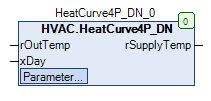
> Heizkurve mit vier Aussentemperatur-Punkten und zwei Kennlinien (Nacht, Tag).
### Darstellung
### Schnittstellen
#### Eingänge
| Name | Datentyp | Wertebereich | Initialwert | Funktion |
| ---------- | -------- | ---------------- | ----------- | ------------------------------------------------------ |
| *rOutTemp* | REAL | -50.0 … +50.0 °C | 0 | Aussentemperatur zur Berechnung der Kennlinien |
| *xDay* | BOOL | | | Betriebsart (FALSE = Nachtbetrieb / TRUE = Tagbetrieb) |
#### Ausgänge
| Name | Datentyp | Wertebereich | Initialwert | Funktion |
| ------------- | -------- | ------------ | ----------- | ------------------------------------------- |
| *rSupplyTemp* | REAL | | 0.0 °C | Vorlaufsolltemperatur der aktiven Kennlinie |
#### Sollwerte / Parameter
| Name | Datentyp | Wertebereich | Initialwert | Funktion |
| ----------------------- | -------- | ------------ | ------------ | --------------------------------------------------------------------------------------------- |
| **eManModeN** | eManNum | | eManNum.Auto | Betriebsart für die Vorlaufsolltemperatur *rSupplyTemp* |
| **rManValue** | REAL | | 0.0 °C | Handwert für die Betriebsart eManNum.Man |
| **rSupplyTempMin** | REAL | | 20.0 °C | Absolute minimale Vorlaufsolltemperatur |
| **rSupplyTempMax** | REAL | | 70.0 °C | Absolute maximale Vorlaufsolltemperatur |
| **rTo1** | REAL | | -15.0 °C | Aussentemperatur für Punkt 1 |
| **rW1Day** | REAL | | 70.0 °C | Vorlaufsolltemperatur für Aussentemperatur-Punkt 1 - Tagkennlinie |
| **rW1Night** | REAL | | 65.0 °C | Vorlaufsolltemperatur für Aussentemperatur-Punkt 1 - Nachtkennlinie |
| **rTo2** | REAL | | -5.0 °C | Aussentemperatur für Punkt 2 |
| **rW2Day** | REAL | | 60.0 °C | Vorlaufsolltemperatur für Aussentemperatur-Punkt 2 - Tagkennlinie |
| **rW2Night** | REAL | | 55.0 °C | Vorlaufsolltemperatur für Aussentemperatur-Punkt 2 - Nachtkennlinie |
| **rTo3** | REAL | | 5.0 °C | Aussentemperatur für Punkt 3 |
| **rW3Day** | REAL | | 50.0 °C | Vorlaufsolltemperatur für Aussentemperatur-Punkt 3 - Tagkennlinie |
| **rW3Night** | REAL | | 45.0 °C | Vorlaufsolltemperatur für Aussentemperatur-Punkt 3 - Nachtkennlinie |
| **rTo4** | REAL | | 15.0 °C | Aussentemperatur für Punkt 4 |
| **rW4Day** | REAL | | 40.0 °C | Vorlaufsolltemperatur für Aussentemperatur-Punkt 4 - Tagkennlinie |
| **rW4Night** | REAL | | 35.0 °C | Vorlaufsolltemperatur für Aussentemperatur-Punkt 4 - Nachtkennlinie |
| **rButtonJump** | REAL | | 1.0 °C | Funktion noch nicht implementiert. |
| **rSupplyTempMaxScale** | REAL | | 90.0 °C | Maximaltemperatur für die Skalierung der Y-Achse (VISU) Schieberegler nur bei 90°C angezeigt! |
| **rBorderDistance** | REAL | | 3.0 °C | Randabstand zum Rand rechts/links in Grad Celsius für die X-Achse (VISU) |
### Funktionsbeschreibung
\
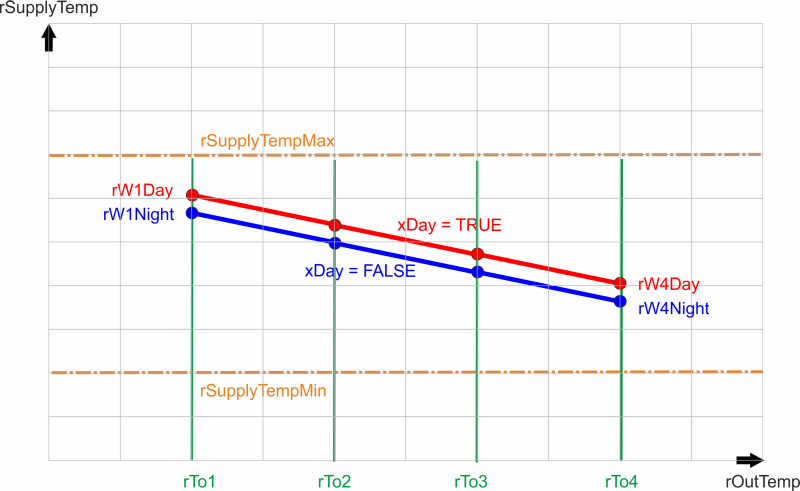
Die Vorlaufsolltemperatur **rSupplyTemp** wird in Abhängigkeit der aktuellen Aussentemperatur **rOutTemp** und der gewählten Kennlinie (Nachtkenlinie: **xDay** = FALSE // Tagkennlinie: **xDay** = TRUE) berechnet.\
Die Vorlaufsolltemperatur \*rSupplyTemp\* wird durch einstellbare absolute Minimal- (**rSupplyTempMin**) und Maximalwerte (**rSupplyTempMax**) begrenzt.\
\
Die Kennlinien sind durch jeweils vier Aussentemperatur-Punkte (getrennt für die Nacht- und Tagkennlinie) definiert und einstellbar.\
Jeder Punkt wird durch eine Aussentemperatur und eine zugeordnete Vorlaufsolltemperatur definiert.\
Die vier Aussentemperatur-Punkte einer Kennlinie werden durch Geraden miteinander verbunden.
{% hint style="danger" %}
Einschränkung
To4 > rTo3 > rTo2 > rTo1
{% endhint %}
\
Der Parameter **eManModeN** erlaubt die Umschaltung der Vorlaufsolltemperatur **rSupplyTemp** vom Automatik- in den Handbetrieb und umgekehrt.\
Im Handbetrieb übernimmt die Vorlaufsolltemperatur \*rSupplyTemp\* den Wert des Parameter **rManValue.**
### Visualisierung
Passendes Visualisierungselement aus der HVACV Visu Library: **HeatCurve4P\_DN**
#### Darstellung
#### Schnittstellen Visu-Element
| Name | Datentyp | Typ | Initialwert | Funktion |
| ----------------------- | --------------- | ------------ | ----------- | ----------------------------------------------------------------------- |
| **FB\_HeatCurve4P\_DN** | HeatCurve4P\_DN | VAR\_IN\_OUT | | FB Instanz HVAC.HeatCurve4P\_DN hier eintragen z.B. PRG.HeatCurve4P\_DN |
{% hint style="info" %}
Hinweis: VAR\_IN\_OUT Schnittstellen müssen belegt werden, VAR\_INPUT sind optional.
{% endhint %}
### CODESYS
InOut:
| Scope | Name | Type | Initial |
| ----------- | --------------------- | ------- | ------------ |
| Input | `rOutTemp` | `REAL` | 0 |
| Input | `xDay` | `BOOL` | |
| Input Const | `rBorderDistance` | `REAL` | 3 |
| Input Const | `rSupplyTempMaxScale` | `REAL` | 90 |
| Input Const | `rButtonJump` | `REAL` | 1 |
| Input Const | `rW4Night` | `REAL` | 35 |
| Input Const | `rW4Day` | `REAL` | 40 |
| Input Const | `rTo4` | `REAL` | 15 |
| Input Const | `rW3Night` | `REAL` | 45 |
| Input Const | `rW3Day` | `REAL` | 50 |
| Input Const | `rTo3` | `REAL` | 5 |
| Input Const | `rW2Night` | `REAL` | 55 |
| Input Const | `rW2Day` | `REAL` | 60 |
| Input Const | `rTo2` | `REAL` | -5 |
| Input Const | `rW1Night` | `REAL` | 65 |
| Input Const | `rW1Day` | `REAL` | 70 |
| Input Const | `rTo1` | `REAL` | -15 |
| Input Const | `rSupplyTempMax` | `REAL` | 70 |
| Input Const | `rSupplyTempMin` | `REAL` | 20 |
| Input Const | `rManValue` | `REAL` | 0 |
| Input Const | `eManModeN` | eManNum | eManNum.Auto |
| Output | `rSupplyTemp` | `REAL` | 0 |
---
# Agent Instructions
This documentation is published with GitBook. GitBook is the documentation platform designed so that both humans and AI agents can read, navigate, and reason over technical content effectively. Learn more at gitbook.com.
## Querying This Documentation
If you need additional information that is not directly available in this page, you can query the documentation by asking a question.
Perform an HTTP GET request on the following URL with the `ask` and `goal` query parameters:
```
GET https://support.powerio.com/hub/codesys-hvac/hvac-library/functionblocks/setpoint/heatcurve4p_dn.md?ask=&goal=
```
`ask` is the immediate question: it should be specific, self-contained, and written in natural language.
`goal` is what the user is ultimately trying to achieve, the reason they need the answer. Sharing it helps GitBook give you a better, more relevant answer. A goal is most helpful when it describes the outcome the user wants rather than restating the question. For example, with `ask=how do I create an API token`, a goal like `automate deployments from our CI pipeline` lets GitBook tailor the answer to that use case.
The response will contain a direct answer to the question and relevant excerpts and sources from the documentation.
Use this mechanism when the answer is not explicitly present in the current page, you need clarification or additional context, or you want to retrieve related documentation sections.