> For the complete documentation index, see [llms.txt](https://support.powerio.com/hub/llms.txt). Markdown versions of documentation pages are available by appending `.md` to page URLs; this page is available as [Markdown](https://support.powerio.com/hub/codesys-hvac/en/hvac-library/functionblocks/setpoint/curve_10xy_real_time.md).
# Curve\_10XY\_Real\_Time
## `Curve_10XY_Real_Time` (FB)
FUNCTION\_BLOCK Curve\_10XY\_Real\_Time
### Short description
> Input of 10 value pairs (support points each with an X and Y value)\
> Boundary conditions:
>
> 1. The X values must be consecutive, either increasing or decreasing
> 2. Two consecutive X values must not be equal
>
> \
> Typical application: Passing a characteristic curve with 10 support points
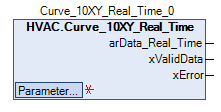
### Representation
### Interfaces
#### Outputs
| Name | Data type | Value range | Initial value | Function |
| ----------------------------- | ------------------- | ----------- | ------------- | -------------------------------------------------------------------------------- |
|
arData\_Real\_Time
| stCurve\_Real\_Time | | | Array with the support points (data type X value: REAL, data type Y value: TIME) |
|
xValidData
| BOOL | | FALSE | Validity of the data in the output array (TRUE = valid) |
|
xError
| BOOL | | FALSE | Error state of the entered support points (TRUE = error) |
#### Setpoints / parameters
| Name | Data type | Value range | Initial value | Function |
| --------------------- | --------- | ----------- | ------------- | -------------------------- |
|
rSP1\_X
| REAL | | 1.0 | Support point 1 - X value |
|
tSP1\_Y
| TIME | | T#1m | Support point 1 - Y value |
|
rSP2\_X
| REAL | | 2.0 | Support point 2 - X value |
|
tSP2\_Y
| TIME | | T#2m | Support point 2 - Y value |
|
rSP3\_X
| REAL | | 3.0 | Support point 3 - X value |
|
tSP3\_Y
| TIME | | T#3m | Support point 3 - Y value |
|
rSP4\_X
| REAL | | 4.0 | Support point 4 - X value |
|
tSP4\_Y
| TIME | | T#4m | Support point 4 - Y value |
|
rSP5\_X
| REAL | | 5.0 | Support point 5 - X value |
|
tSP5\_Y
| TIME | | T#5m | Support point 5 - Y value |
|
rSP6\_X
| REAL | | 6.0 | Support point 6 - X value |
|
tSP6\_Y
| TIME | | T#6m | Support point 6 - Y value |
|
rSP7\_X
| REAL | | 7.0 | Support point 7 - X value |
|
tSP7\_Y
| TIME | | T#7m | Support point 7 - Y value |
|
rSP8\_X
| REAL | | 8.0 | Support point 8 - X value |
|
tSP8\_Y’\*
| TIME | | T#8m | Support point 8 - Y value |
|
rSP9\_X
| REAL | | 9.0 | Support point 9 - X value |
|
tSP9\_Y
| TIME | | T#9m | Support point 9 - Y value |
|
rSP10\_X
| REAL | | 10.0 | Support point 10 - X value |
|
tSP10\_Y
| TIME | | T#10m | Support point 10 - Y value |
### Function description
\
The array at the output arData\_Real\_Time is filled with the entered data of the 10 support points if
1. there is no active error in the entry of the support points (xError = FALSE) AND
2. a value change has occurred in the entered data
\
The output **xValidData** is active (= TRUE) if the data in the output array are valid. The data in the output array may differ from the entered data if the entered data contain an error.\
\
When specifying the X values the following boundary conditions apply:\
\
1\) The X values must be consecutive, either increasing or decreasing\
2\) Two consecutive X values must not be equal\
\
The output **xError** is active (= TRUE) if at least one of these two conditions is not fulfilled.\
It is not active (= FALSE) if both conditions are fulfilled.
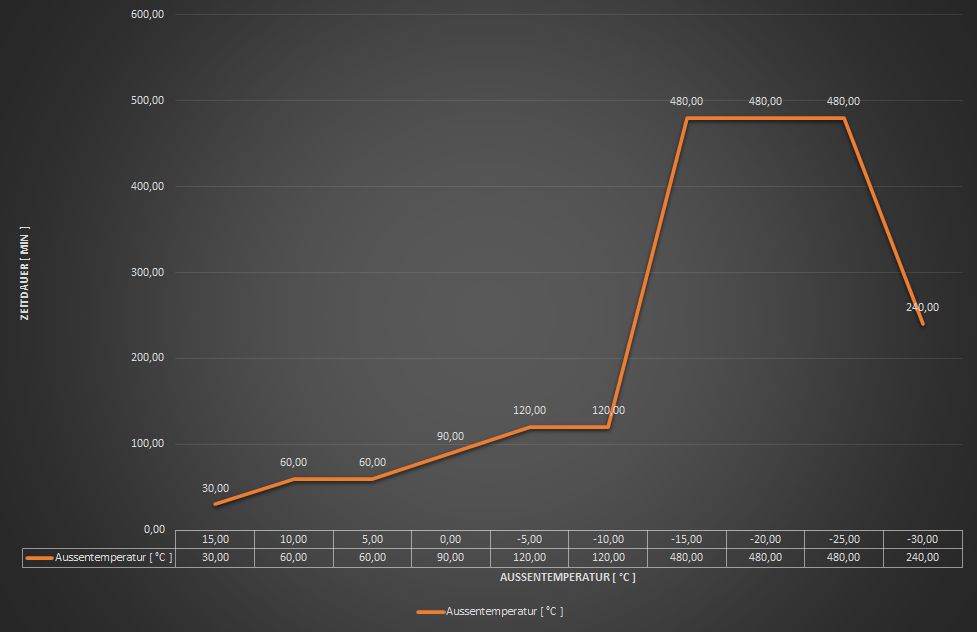
### Representation of an example characteristic curve
### CODESYS
InOut:
| Scope | Name | Type | Initial |
| ----------- | ------------------ | ------------------------------------- | ------------- |
| Output | `arData_Real_Time` | ARRAY \[1..10] OF stCurve\_Real\_Time | |
| Output | `xValidData` | `BOOL` | FALSE |
| Output | `xError` | `BOOL` | FALSE |
| Input Const | `tSP10_Y` | `TIME` | TIME#10m0s0ms |
| Input Const | `rSP10_X` | `REAL` | 10.0 |
| Input Const | `tSP9_Y` | `TIME` | TIME#9m0s0ms |
| Input Const | `rSP9_X` | `REAL` | 9.0 |
| Input Const | `tSP8_Y` | `TIME` | TIME#8m0s0ms |
| Input Const | `rSP8_X` | `REAL` | 8.0 |
| Input Const | `tSP7_Y` | `TIME` | TIME#7m0s0ms |
| Input Const | `rSP7_X` | `REAL` | 7.0 |
| Input Const | `tSP6_Y` | `TIME` | TIME#6m0s0ms |
| Input Const | `rSP6_X` | `REAL` | 6.0 |
| Input Const | `tSP5_Y` | `TIME` | TIME#5m0s0ms |
| Input Const | `rSP5_X` | `REAL` | 5.0 |
| Input Const | `tSP4_Y` | `TIME` | TIME#4m0s0ms |
| Input Const | `rSP4_X` | `REAL` | 4.0 |
| Input Const | `tSP3_Y` | `TIME` | TIME#3m0s0ms |
| Input Const | `rSP3_X` | `REAL` | 3.0 |
| Input Const | `tSP2_Y` | `TIME` | TIME#2m0s0ms |
| Input Const | `rSP2_X` | `REAL` | 2.0 |
| Input Const | `tSP1_Y` | `TIME` | TIME#1m0s0ms |
| Input Const | `rSP1_X` | `REAL` | 1.0 |
---
# Agent Instructions
This documentation is published with GitBook. GitBook is the documentation platform designed so that both humans and AI agents can read, navigate, and reason over technical content effectively. Learn more at gitbook.com.
## Querying This Documentation
If you need additional information that is not directly available in this page, you can query the documentation dynamically by asking a question.
Perform an HTTP GET request on the current page URL with the `ask` query parameter, and the optional `goal` query parameter:
```
GET https://support.powerio.com/hub/codesys-hvac/en/hvac-library/functionblocks/setpoint/curve_10xy_real_time.md?ask=&goal=
```
`ask` is the immediate question: it should be specific, self-contained, and written in natural language.
`goal` is optional and describes the broader end goal you are ultimately trying to accomplish on behalf of the user. GitBook uses it to tailor the answer towards what is most useful for that goal.
The response will contain a direct answer to the question and relevant excerpts and sources from the documentation.
Use this mechanism when the answer is not explicitly present in the current page, you need clarification or additional context, or you want to retrieve related documentation sections.